Choose a starting ring
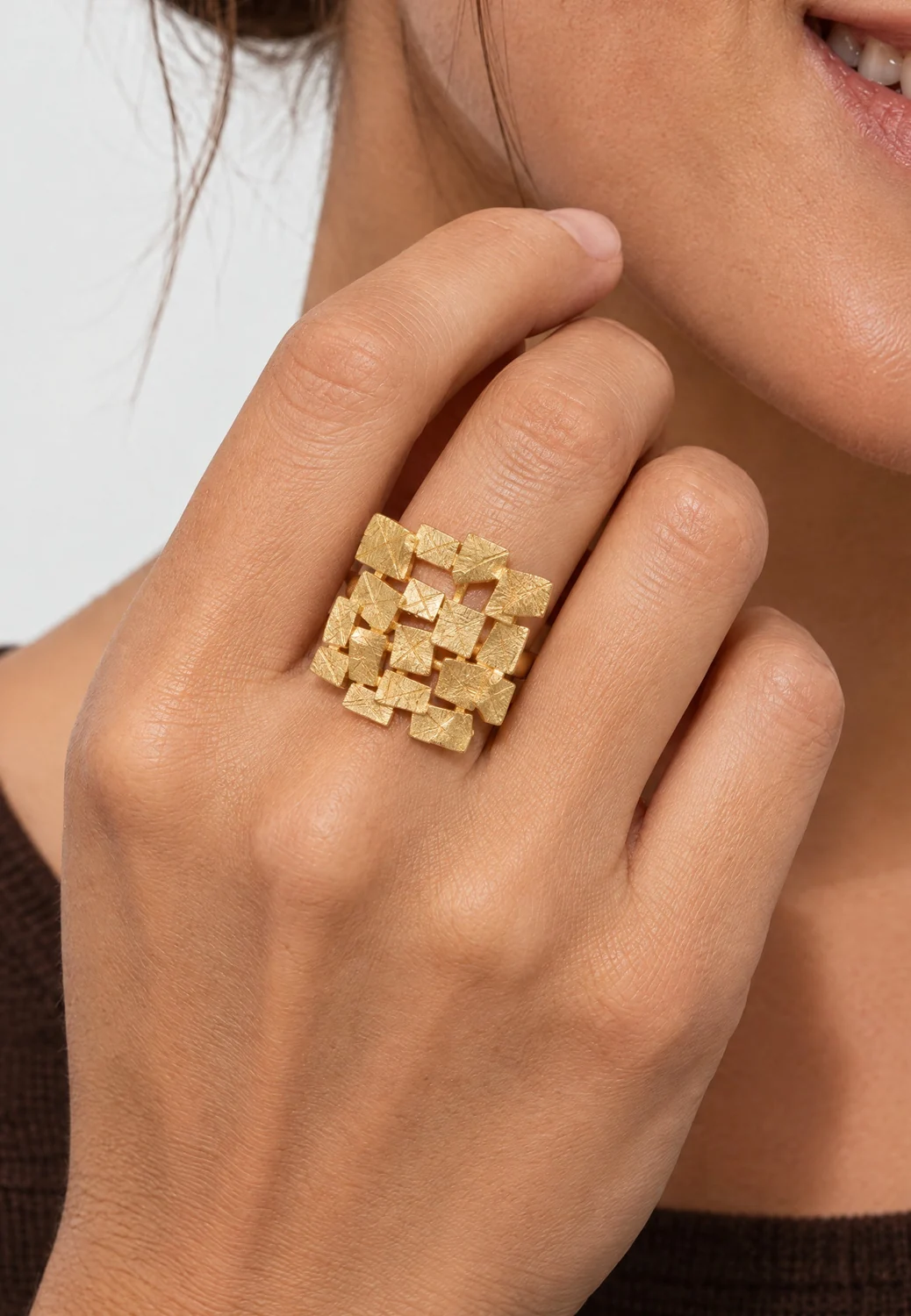
Build a ring arrangement from a piece you already understand: a familiar band, a textured surface or a shape you like on one finger. Wear it alone first and note where it sits. Our editorial suggestion is to choose a single starting point rather than planning every finger at once. A stack can mean two rings on one finger or a considered group across the hand; neither needs to fill all the available space to feel deliberate.
Use one measured starting point
For a narrow textured starting point, Heideman's Damenring Partis supplies a specific reference: the listing identifies 316L stainless steel with 18K gold plating and a width of 3 mm. That width describes the band, not the ring size. Our suggestion is to compare its texture with a smoother piece while reading the maker's sizing guidance for each ring. Do not assume a size that suits one narrow band will feel identical when several rings sit together on the same finger.
Add one contrast
Place a second ring beside the first and look for one useful difference: a finer line next to a broader band, a smooth surface beside a more articulated form, or an open gap beside a solid curve. This is an editorial experiment rather than a matching formula. If both rings demand equal attention, try moving one to another finger. The goal is to see each piece clearly, not to make every surface carry the same amount of detail.
Use the empty intervals
The spaces between rings help define their outlines. Look at the hand with fingers relaxed, not only spread for a photograph, and notice whether the pieces merge into one block. Leaving a finger bare or changing the distribution can give a substantial band more presence. Our suggestion is to remove one piece before adding a third whenever the composition feels crowded. Empty space is an active choice, especially beside an unusual profile or a wide surface.
Check the moving hand
Curl the fingers gently, hold a pen and perform a few ordinary gestures while assessing the arrangement. Rings may meet each other, press against adjacent fingers or turn as the hand moves. A styling article cannot establish a comfortable fit for an individual hand. Avoid forcing a stack into place or treating contact between surfaces as harmless by default. If the combination feels restrictive, reduce the number of pieces and reconsider their size or placement.
Store the pieces as individuals
After wearing, separate the rings so their edges and surfaces are easy to inspect. Keep track of the finger and combination you preferred, but do not leave pieces pressed together simply to preserve a stack. Follow the maker's current care guidance for every finish involved. Our practical addition is a small note or photograph of successful pairings; it lets you recreate the arrangement while giving each ring its own space between wears.
Sources & further reading
- Heideman official source — Build a ring stack one interval at a time (1)
- Heideman official source — Build a ring stack one interval at a time (2)
Product specifications and availability may change. Check the official page and care guidance for the exact item. Styling suggestions are editorial ideas; material, water-resistance, allergy and durability claims must be verified for the individual product.