Start with an everyday neckline
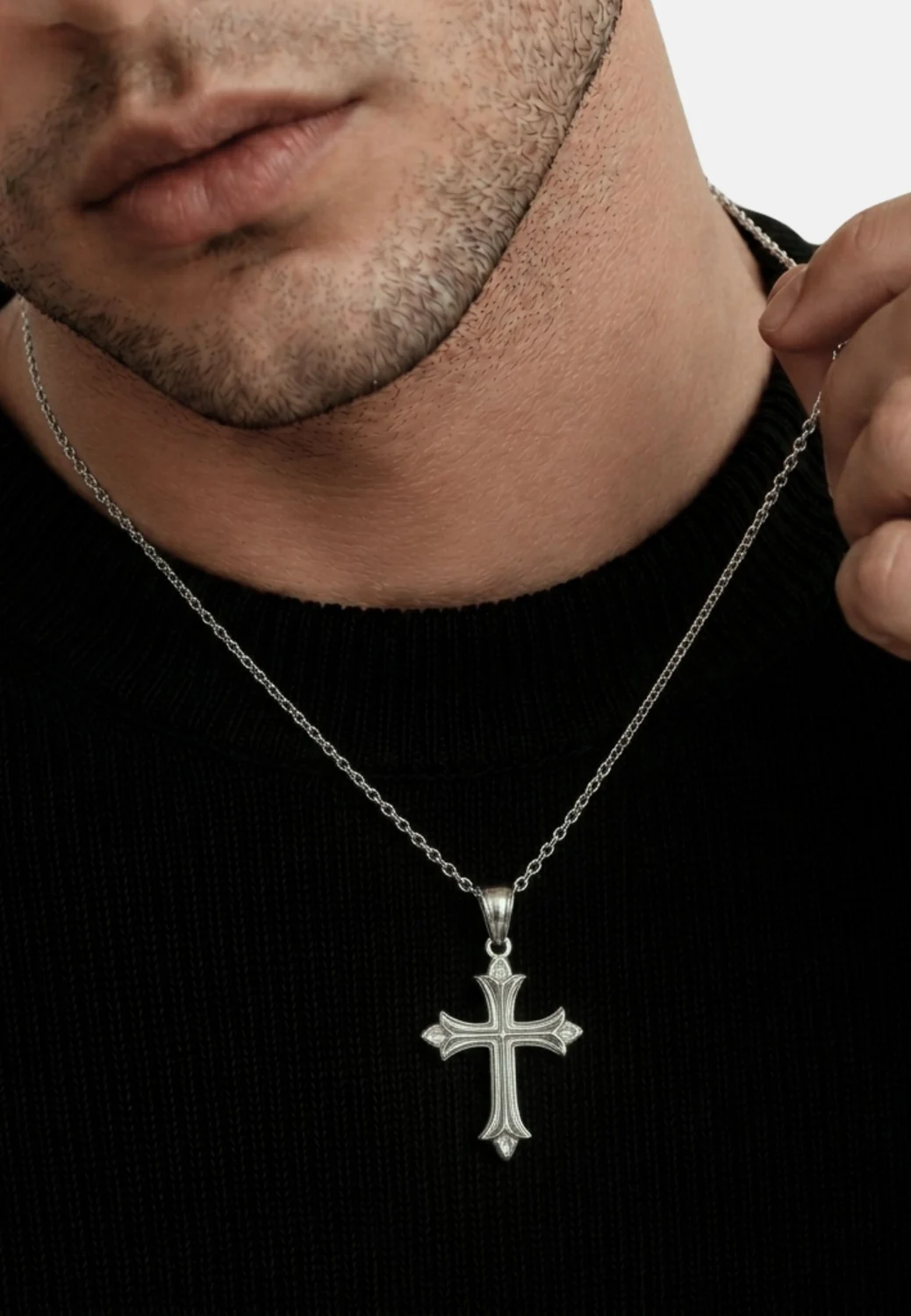
Choose the shirt or knit you wear most often and use it as the first setting for a chain. A crew neck creates a horizontal boundary; an open collar creates a longer space. Our editorial suggestion is to judge the necklace in that familiar context before changing the rest of the outfit. The question is where the chain becomes visible and whether that line looks intentional at the distance of an ordinary conversation.
Read the Hiro construction
Heideman's Kette Hiro combines a cross pendant with a fine chain. Its official listing identifies silver-coloured 316L stainless steel, a lobster clasp and a length of 46 cm plus a 5 cm extension; silver colour does not mean sterling silver. Our suggestion is to treat the cross as the focal point when choosing a neckline. Men's jewellery is an editorial browsing category here, not a rule about who can wear it, and the pendant's personal meaning is for the wearer to decide.
Choose the amount of visibility
A chain can stay mostly inside a shirt, trace the opening of a collar or sit fully over fabric. Try each position with the actual garment and decide how much of the line you want to show. There is no need to make an entire necklace visible for it to function as a deliberate detail. If a collar repeatedly catches or hides the links, adjust the garment or consider another listed length rather than forcing the chain into place.
Let link scale do some work
Compare the width and openness of the links with the texture of the clothing. Fine lines may read quietly against a plain tee, while a more pronounced pattern can remain visible beside a substantial knit. These are styling suggestions, not instructions to match jewellery to body size or gender. Look at the chain alongside the whole outfit and choose the degree of contrast you enjoy, rather than selecting the largest piece merely because a close-up makes it look decisive.
Keep other details purposeful
A ring, watch or bracelet can support the chain without repeating every element. Begin with one familiar accessory and decide which object should lead the eye. Matching metal colours can produce continuity; using different finishes can also work if you like the result. Our suggestion is to repeat a simple line or rounded shape, then stop adding when the composition already feels clear. An uncomplicated chain worn alone is a complete styling choice.
Build a routine around the clasp
Before wearing, check that the clasp engages properly and the chain is free of twists. Follow the maker's current care instructions rather than assuming a metal chain needs no attention. After wearing, lay it separately with the fastening easy to find. If a pendant or another necklace is added later, read its construction and compatibility information in its own listing; a similar colour does not establish that a clasp, loop or finish is designed for every combination.
Sources & further reading
- Heideman official source — A men's chain in the full outfit (1)
- Heideman official source — A men's chain in the full outfit (2)
Product specifications and availability may change. Check the official page and care guidance for the exact item. Styling suggestions are editorial ideas; material, water-resistance, allergy and durability claims must be verified for the individual product.