Begin with the pendant's boundary
Before considering symbolic meaning or an outfit, trace the pendant's outer edge. A compact rounded form, a long vertical line and an open shape each direct attention differently. Our editorial suggestion is to choose the outline that interests you first, then examine how it is suspended. The loop or point of attachment is part of the visible design, and the relationship between pendant and chain often matters as much as either object viewed alone.
Read the Freya construction
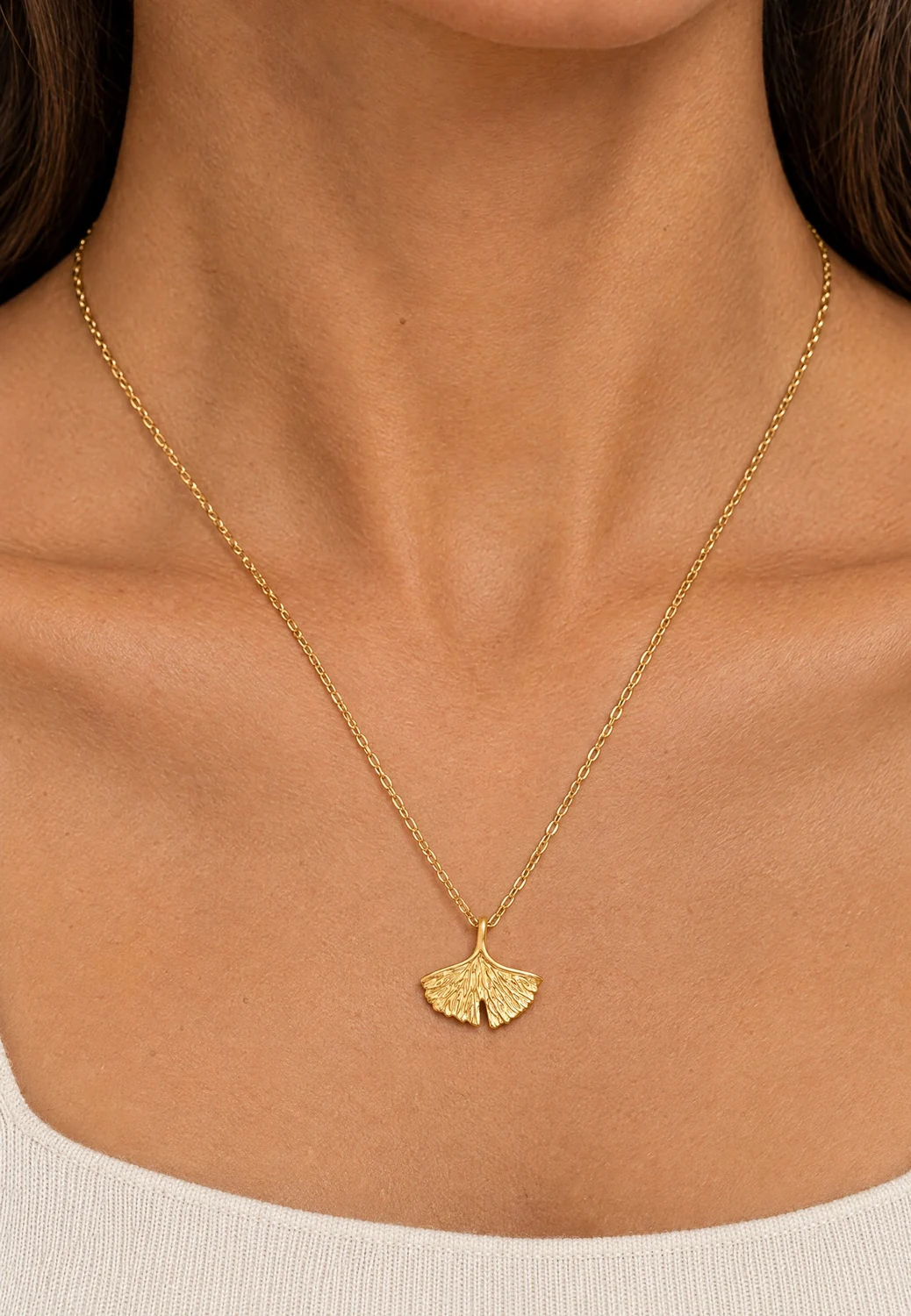
Heideman's Kette Freya presents a fan-shaped ginkgo-leaf pendant on a fine linked chain. The official description identifies 316L stainless steel with 18K gold plating, a lobster clasp and an extension chain. These are construction details of this model; they do not supply an unlisted numerical necklace length. Our suggestion is to compare the fan's broad edge and narrow suspension point as one shape, then judge the chain's placement with your own neckline rather than estimating scale from a close-up.
Place it within the neckline
Try the necklace with the actual garment you plan to wear. A pendant may occupy the open space of a collar, sit over fabric or disappear behind a neckline, and each choice changes the composition. Look from the front while standing naturally. Our suggestion is to find a clear relationship with a garment edge rather than aiming for an abstract ideal position. What works on one shirt may need a different adjustment on another.
Use distance to judge scale
A detailed product crop can make a small pendant dominate the page. Step back from a mirror or take a photograph that includes the shoulders and upper body to see its role in an outfit. Compare that view with the close-up: one explains placement, the other explains detail. Neither is a complete substitute for the other. Choose the degree of presence you enjoy without turning the pendant's size into a rule about body shape or who should wear it.
Decide what should accompany it
A pendant already supplies a focal point, so another necklace changes the balance. Begin by wearing it alone, then try a plain chain if you want a second line. Look at the gap between the two and check that their attachments are not repeatedly meeting. Alternatively, a ring or small earrings can carry the supporting detail elsewhere. This is an editorial approach to visual emphasis, not a requirement to keep every other piece small.
Store the focal point without a knot
After wearing, lay the pendant and its chain down carefully, keeping the clasp identifiable. If the pendant is designed to be removable, follow the maker's instructions for separating it; do not force a loop or fastening. Store the necklace apart from other chains and use the relevant care advice for every component. Our practical recommendation is to note the adjustment you preferred with a favourite neckline so the next wear begins with a useful reference.
Sources & further reading
- Heideman official source — A pendant and its place in the frame (1)
- Heideman official source — A pendant and its place in the frame (2)
Product specifications and availability may change. Check the official page and care guidance for the exact item. Styling suggestions are editorial ideas; material, water-resistance, allergy and durability claims must be verified for the individual product.